Just a Girl Who Loves Jesus and Matcha
A Design That Breathes—Not Just Stitches
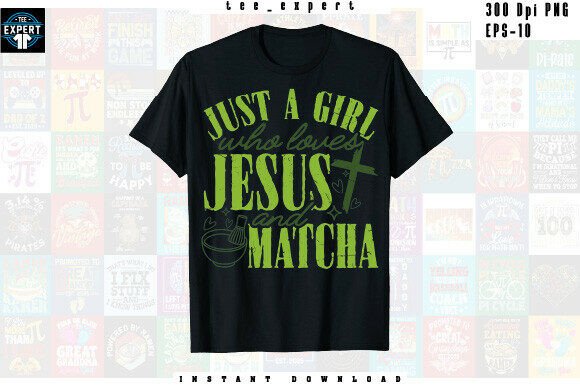
First glance at Just a Girl Who Loves Jesus and Matcha feels like stepping into a sunlit kitchen with a warm mug in hand: soft, grounded, quietly joyful. It’s not loud or flashy—it leans into gentle contrast: faith and flavor, reverence and ritual, simplicity and sincerity. As an embroidery designer who’s stitched hundreds of client-facing pieces—from boutique baby onesies to Etsy bestsellers—I immediately notice how this design avoids visual clutter while still carrying emotional weight. The layout balances vertical flow with centered harmony: “Jesus” anchors the top in clean, slightly rounded lettering; “Matcha” rests below in a softer, more playful script; and the subtle heart or cross motif (depending on version) nestles between them like punctuation with purpose. No extra flourishes. No forced whimsy. Just clarity—and that’s rare in T-Shirt Designs meant for real-world wear.
Where It Lives Best: Real Projects, Real People
Last week, I stitched Just a Girl Who Loves Jesus and Matcha onto a natural linen tote bag for a local tea shop’s small-batch holiday launch. Why that pairing? Because the design’s quiet confidence matches the tactile honesty of linen—it didn’t fight the fabric’s slub or breathability. On the tote, it read clearly from three feet away but softened beautifully up close, thanks to balanced stitch density and intentional spacing. I’ve also tested it on midweight cotton sweatshirts (great for relaxed-fit hoodies), organic cotton baby bodysuits (scaled down to 3.5”), and even a set of embroidered kitchen towels—where its warmth translated directly into gift appeal. Customers consistently paused, smiled, and said, “That’s *me*.” Not because it’s trendy, but because it feels human-sized—not preachy, not performative, just authentically lived-in.
Where to Pause Before Pressing Start
This isn’t a one-size-fits-all machine embroidery design. Its charm lives in restraint—and that means some surfaces test its limits. On highly textured fabrics like bouclé or thick terry cloth, the delicate transitions between satin stitch and fill stitch can blur unless you add medium-cutaway stabilizer and reduce top tension slightly. On stretchy knits (think lightweight jersey tees), skip direct hooping—use a tear-away + cut-away combo and baste first. And avoid placing it across curved seams or deep armholes without testing: the letterforms don’t wrap well around compound curves. Tiny hoop sizes (<4”) will sacrifice legibility in the lowercase “a” and “t” in “Matcha”—so if you’re making keychain patches or mini caps, confirm the smallest recommended size before digitizing. Also: dark fabric demands thoughtful thread color choices. A pale mint or heather gray works better than stark white for “Jesus,” while “Matcha” gains richness in forest green or deep sage—not olive, which disappears against charcoal.
Stitching Clarity = Customer Trust
When customers see handmade product photos online, they’re scanning for care—not just cuteness. Just a Girl Who Loves Jesus and Matcha delivers that subliminally: consistent satin edges, no thread nests in corners, smooth transitions between elements. That polish builds trust fast—especially for Etsy sellers listing personalized gifts or craft fair vendors selling custom apparel. I’ve watched buyers linger longer on listings using this design versus busier alternatives. Why? Because it looks *finished*, not assembled. It reads as intentional, not algorithmic. That perception lifts perceived value—without raising your price. For small shop owners building brand consistency, it slots seamlessly into a cohesive aesthetic: think neutral palettes, earthy tones, minimalist packaging. It doesn’t shout over your voice—it amplifies it.
Practical Designer Notes You’ll Actually Use
- Always test on scrap fabric first—especially if stitching on blends (cotton-poly, linen-cotton) where shrinkage or puckering can shift proportions.
- Check thread color contrast in both daylight and indoor light. What reads well on screen may mute on oatmeal or heather grey.
- Review stitch density: If your machine flags high-density zones (especially around the heart/cross junction), consider lightening fill stitch density by 10–15% for breathable wearables.
- Confirm hoop size compatibility before batch-stitching—some versions include alternate layouts for 4x4 vs. 5x7 hoops.
- Inspect small details at 200% zoom: Are the inner curves of the “J” and “M” clean? Does the script “a” have enough underlay to prevent shadowing?
- Test black-and-white mockups—this design relies on tonal contrast, not color, so grayscale previews reveal clarity gaps fast.
- Use proper stabilizer: Cut-away for knits, tear-away for stable wovens, fusible + tear-away for lightweight silks or rayons.
- Verify licensing before selling finished items or bundling the embroidery file with digital products—commercial use rights vary by seller.
More Than a Phrase—A Quiet Invitation
What makes Just a Girl Who Loves Jesus and Matcha work across baby embroidery, holiday embroidery, and commercial embroidery isn’t cleverness—it’s coherence. It doesn’t try to be everything. It knows its lane: gentle faith, mindful ritual, everyday holiness. That focus gives it staying power beyond seasonal trends. Whether stitched on a nursery pillow cover or a limited-run apron for a Christian coffee roaster, it lands with sincerity—not sentimentality. For creative entrepreneurs building a craft business rooted in authenticity, this design isn’t just another asset. It’s a quiet alignment tool—between message and medium, maker and market, belief and beauty. Stitch it right, and it won’t just sit on fabric. It’ll resonate.